The T.V.M. solver is based on the concept that an investor would rather receive a fixed amount of money today, opposed to getting that same amount of money on a future date. Basically the time value of money represents the interest you would earn on a payment received today, if held, earning interest, until that future date.
To open the T.V.M. solver on your calculator you simply need to prees [APPS], [ENTER], [ENTER] which will bring you to a screen with the following variables:
N: Number of compounding periods. Type this in as number of years times number of compounding periods per year.
I%: Interest rate. Type this in as a rate, NOT as a decimal.
PV: Previous Value. This is the starting value of the account. If it’s a loan, the amount will be positive, the amount you owe. If it’s a savings account, the amount will be negative, the amount you (take out of your pocket and) put in. If you don’t start the savings account with a deposit, this value will be zero.
PMT: Payment amount. Since this is coming out of your pocket, it’s negative. If you’ve started a savings account with a deposit, and don’t plan to make regular deposits, this will be zero.
FV: Future value. For savings, this will be the value after a given number of compounding periods. For a loan, this should be 0.
P/Y: Payments per year. This number should be the same as the next item, unless specified otherwise in the problem.
C/Y: Compounding periods per year. See above.
PMT: END BEGIN: Will the payments be due at the beginning or end of
the month.
__________________________________________________________________
EXAMPLE
1.) Now, suppose you are taking out a 5-year loan on $25000 at 6% annual interest compounded monthly and you want to know the monthly payment. Fill in the values on the TVM Solver screen as shown:
(Enter N as 5 years * 12 compounding periods per year)
N=60
I%=6
PV=25000
PMT=
FV=0
P/Y=12
C/Y=12
PMT=END
2.) Now, move the cursor to PMT, press the green ALPHA key, then ENTER.
Your payment will show up as a negative number (since it’s coming out of your
pocket):
N=60
I%=6
PV=25000
PMT=-483.32003...
FV=0
P/Y=12
C/Y=12
PMT=END
3.) Suppose you know you can afford a $250 per month payment on a 60 month loan at 6% annual interest compounded monthly. You can enter N as 60, since
they didn’t give you a number of years. Fill out the TVM Solver screen as
shown:
N=60
I%=6
PV=0
PMT=-250
FV=0
P/Y=12
C/Y=12
PMT=END
4.) To find how much you can afford to borrow, move the cursor to PV, press the
green ALPHA key, then ENTER. The amount you can afford to borrow is
shown:
N=60
I%=6
PV=12931.39019
PMT=-250
FV=0
P/Y=12
C/Y=12
PMT=END
Showing posts with label Omar. Show all posts
Showing posts with label Omar. Show all posts
Tuesday, December 9, 2008

Friday, December 5, 2008
Monday, November 3, 2008
Nov 3
Today we handed in mental math 20 - 30 for marks. Then we went over Exercise #2.


We are going over exercise #3 first thing tomorrow. NON- LINEAR FUNCTIONS TEST ON THURSDAY
Thursday, October 9, 2008
Non - Linear Functions
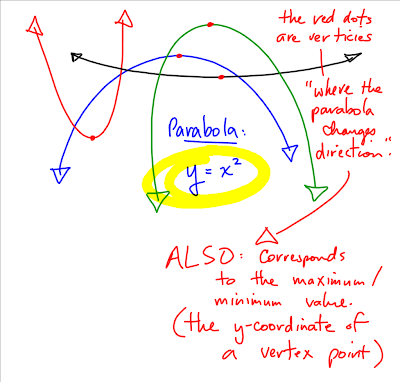
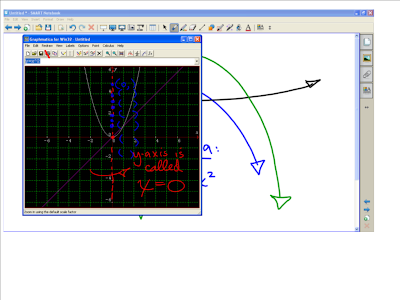
Today we started with mental math as usual. Then went on to some notes on Non - Linear Functions, Quadratic Functions in particular.


The lines below are known as the parabola and the red dot is indicating the vertex which is where the parabola changes direction.


How to pronounce PARABOLA.


Assigned is exercise 1 in the booklet we received today ASAP (whenever we get a chance to do it)
Tuesday, October 7, 2008
Selection Reflection
This is a review for exam time to myself and anyone else studying for the exam. Our first unit was on solving linear equations I am pretty confident with this unit so here you go.
First off you need to know that a system is 2 or more equations being considered at the same time:
y=2x+5
y=-3x-1 <------ this is a system
You should also know the different types of systems and be able to tell the difference between them: consistent is when the equations cross, inconsistent is when the equations are parallel and dependant is when the the equations are directly on tip of each other.
The next thing you should know is how to solve these equations using both the algebraical methods, which are the substitution and the addition/subtraction methods and how to solve them non-algebraical methods which involve using either graphmatica or a graphing calculator.
The final thing we learned how to do is word problems which aren't all that hard if you don't have trouble turning the words into an equations.
I hope this helps me and all of you reading this on the exam.
First off you need to know that a system is 2 or more equations being considered at the same time:
y=2x+5
y=-3x-1 <------ this is a system
You should also know the different types of systems and be able to tell the difference between them: consistent is when the equations cross, inconsistent is when the equations are parallel and dependant is when the the equations are directly on tip of each other.
The next thing you should know is how to solve these equations using both the algebraical methods, which are the substitution and the addition/subtraction methods and how to solve them non-algebraical methods which involve using either graphmatica or a graphing calculator.
The final thing we learned how to do is word problems which aren't all that hard if you don't have trouble turning the words into an equations.
I hope this helps me and all of you reading this on the exam.
Wednesday, September 17, 2008
Accelerated Math Sept. 17/08
Alright, today we started off by doing mental math which usually has a lot to do with the lesson we do the day before, so try and pay attention. Then we were shown how to do accelerated math:

I don't think there is to much i can add to that, but if you have any questions don't be shy to ask. There is a test coming up next week, Thursday September 25 to be exact and accelerated math would probably give you some good practise so get er done.
Friday, September 12, 2008

Subscribe to:
Posts (Atom)

